Why two trades with the same payroll pay different premiums
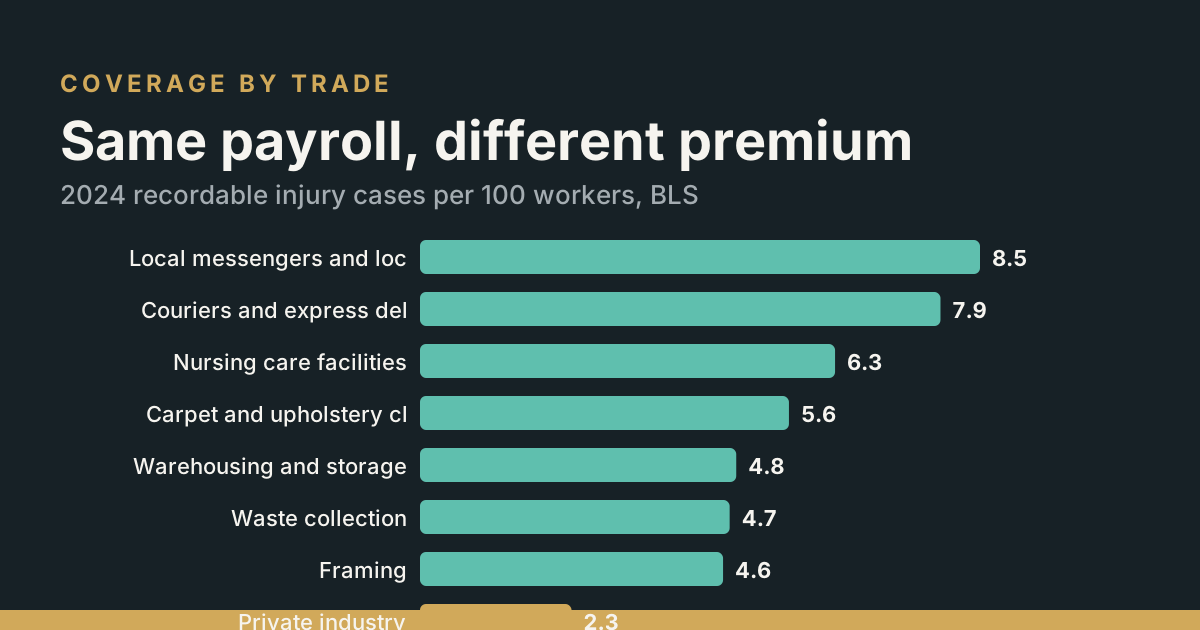
A workers' compensation premium is, at its simplest, payroll divided by 100 and multiplied by a class rate, then adjusted by an experience modifier built from your own claims. The class rate is set per state and per classification, and it follows the loss record of everyone in that class. That is why the BLS injury figures on this site are the closest public proxy for where a trade's premium starts.
The spread in 2024
| Trade | Recordable cases per 100 FTE |
|---|---|
| Local messengers and local delivery | 8.5 |
| Couriers and express delivery services | 7.9 |
| Nursing care facilities | 6.3 |
| Carpet and upholstery cleaning services | 5.6 |
| Warehousing and storage | 4.8 |
| Waste collection | 4.7 |
| Framing contractors | 4.6 |
| Used household and office goods moving | 4.3 |
| Private industry, all | 2.3 |
Across the 37 trades on this site the rate runs from 1.5 (security guards and patrol services) to 8.5 (local messengers and local delivery). Two businesses with identical payroll at those two ends start from class rates that differ by roughly that ratio before anyone has looked at their own record.
Severity matters as much as frequency
The recordable rate counts every OSHA-recordable case. The DART rate counts the serious ones — days away, restriction or transfer — and those are the claims that pay indemnity as well as medical cost and that move the experience modifier. A trade can have a middling recordable rate and a high share of serious cases, which is why each trade page shows both.
What you can change
The class rate is the industry's; the experience modifier is yours. A documented safety programme, prompt return-to-work, and a few clean years do more for the premium in a high-rate trade than shopping carriers. In a low-rate trade the premium is driven by liability lines instead, and there the lever is the certificate requirements in your contracts. The risk rankings put every trade here on the same scale.
The liability side moves the other way
Workers' compensation follows injury frequency, but general liability follows the severity of what can go wrong to a third party, and the two do not line up. Tile contractors have one of the lowest injury rates here and a long-tail waterproofing exposure; security guards have a modest injury rate and an assault-and-battery exposure that standard forms exclude. Reading a quote line by line — comp, GL, auto, umbrella — shows which of your numbers is doing the work, and that is the only way to know which lever to pull.