Business insurance when you have no employees
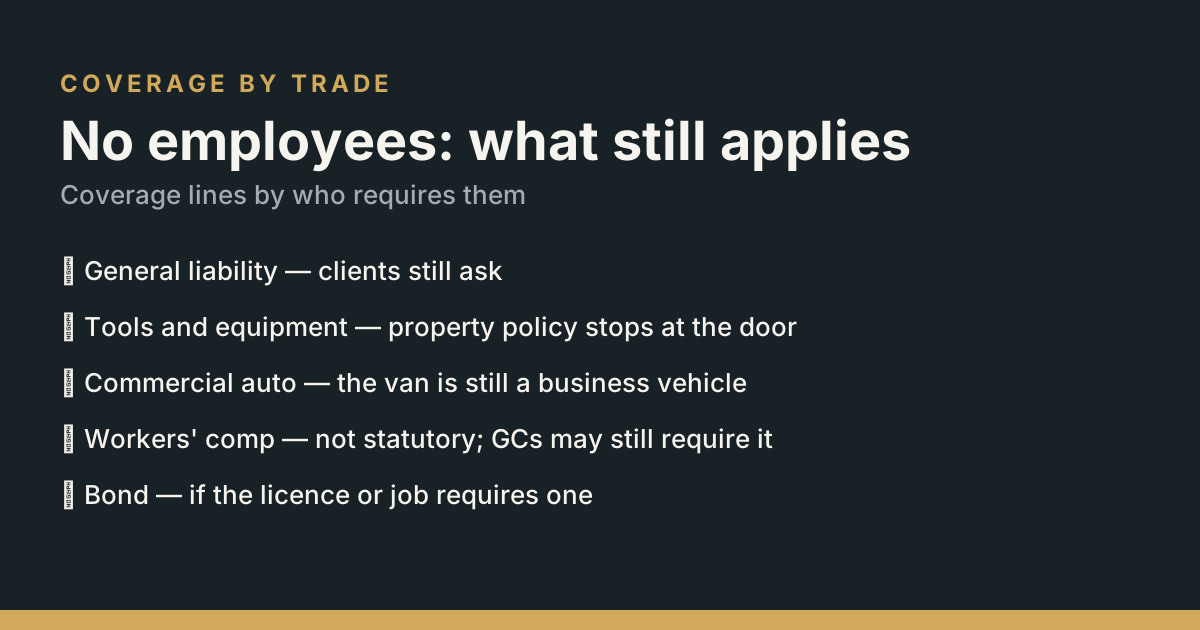
Workers' compensation is the one line nearly every state requires once a business has employees, so a one-person operation often assumes it needs nothing. That is wrong in two ways.
The lines that do not depend on employees
- General liability — the client's exposure is the same whether you bring a crew or not. Certificates are asked of sole proprietors every day.
- Tools and equipment — a property policy covers things at your address; an inland marine floater covers them in the van and on the job.
- Commercial auto — a personal policy excludes business use beyond commuting. The van is a business vehicle with or without a passenger seat filled.
- Professional liability — if you design, specify, inspect or advise, the exposure is yours alone.
- Bonds — licence bonds and job bonds attach to the contractor, not the headcount.
Why workers' comp still comes up
General contractors and some clients require a workers' compensation certificate from every subcontractor regardless of size, because without one their own policy may be charged for your payroll at audit. In most states a sole proprietor can buy a policy covering themselves, or file an exemption the GC will accept; which is available, and whether a "ghost policy" is acceptable, is a state question.
Using the checklist
The checklist tool removes workers' compensation when "I have employees" is unticked and commercial auto when no vehicles are used, and leaves the rest. For most trades here that still produces four or five lines — the same lines a one-person business is asked for on its first commercial job.
Three mistakes sole proprietors make
- Relying on the client's policy. A general contractor's insurance does not cover a subcontractor's own liability; the contract usually makes the sub indemnify the GC, which is the reverse.
- Letting the personal auto policy carry the van. Business-use exclusions are enforced after a claim, not before, and a denied auto claim is the fastest way a one-person business ends.
- Buying the cheapest general liability without reading the exclusions. Roofing, hot work, subsidence, pollution and "your work" exclusions are common on budget forms and remove exactly the claims a trade is most likely to have.
A broker who writes your trade will know which exclusions to negotiate out; the coverage pages list what to ask for each line.