How to read a certificate of insurance
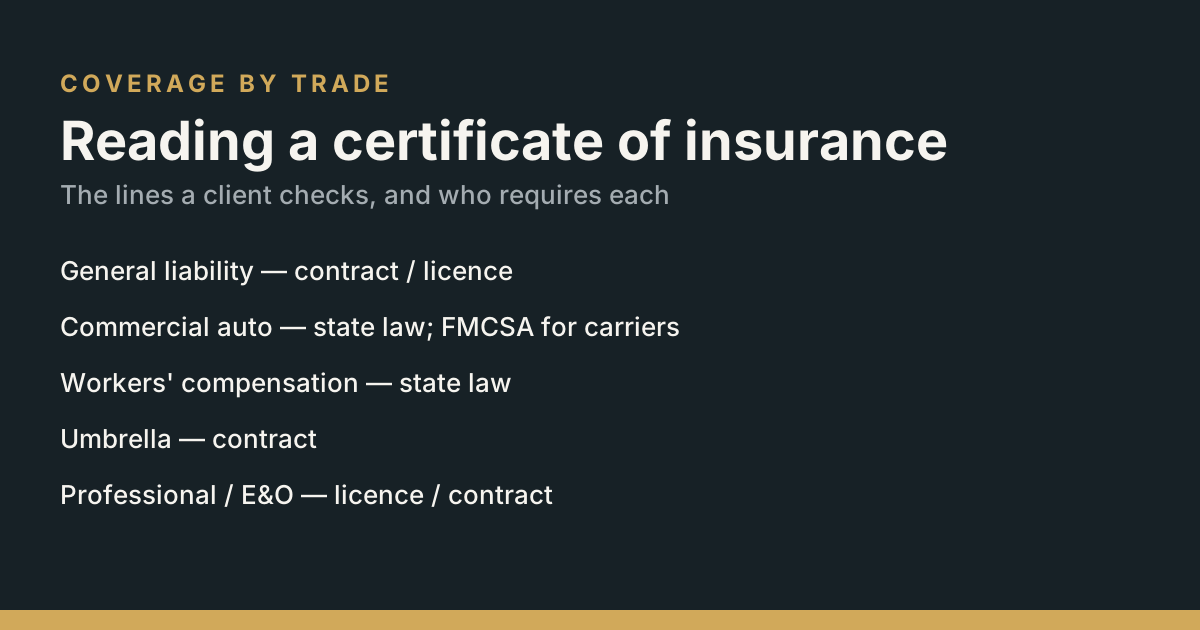
A certificate of insurance is a one-page summary an insurer or broker issues to show a third party — a client, a landlord, a general contractor — what policies you carry. It is evidence, not a contract: the certificate holder gets no rights from it unless an endorsement on the policy itself gives them.
The lines
- General liability — the line almost every certificate request is about. Shows per-occurrence and aggregate limits, and whether products/completed operations are included. Required by contracts and licences, not by federal law.
- Automobile liability — any auto, owned, hired or non-owned. State minimums apply to every vehicle; interstate for-hire carriers must meet the 49 CFR 387.9 schedule ($0.75M, $1M, $5M).
- Umbrella / excess — extra limits over the lines above; a contract requirement.
- Workers' compensation and employer's liability — the statutory line; nearly every state requires it once there are employees.
- Other — professional liability, pollution, cargo, liquor, inland marine, as the trade needs.
Additional insured, waiver of subrogation, primary and non-contributory
These three phrases appear in most contract insurance clauses. Additional insured extends your general liability to cover the holder for claims arising from your work; it needs an endorsement on the policy, and the certificate should name the form. Waiver of subrogation stops your insurer from pursuing the holder after paying a claim. Primary and non-contributory means your policy pays first and does not look to the holder's own insurance. Each one changes what the holder can recover from your policy, which is why they are negotiated.
Which lines a law requires
Only two: workers' compensation (state law, with thresholds that vary) and auto liability (state minimums for any vehicle; federal minimums for interstate carriers). Everything else on the certificate is there because someone with leverage asked for it. The coverage pages take each line in turn.
Dates, cancellation and the policy itself
Two more things to check. The policy period on each line: a certificate issued in March for a policy that renews in April is evidence of very little, and the holder should ask for the renewal certificate. And the cancellation notice: the standard ACORD form says the insurer will endeavour to give notice, which is not a promise; a contract that requires 30 days' notice needs an endorsement on the policy to make it one. When a dispute arises the certificate is not what gets read — the policy and its endorsements are — so a holder with real exposure asks for the endorsement pages, not just the summary.